
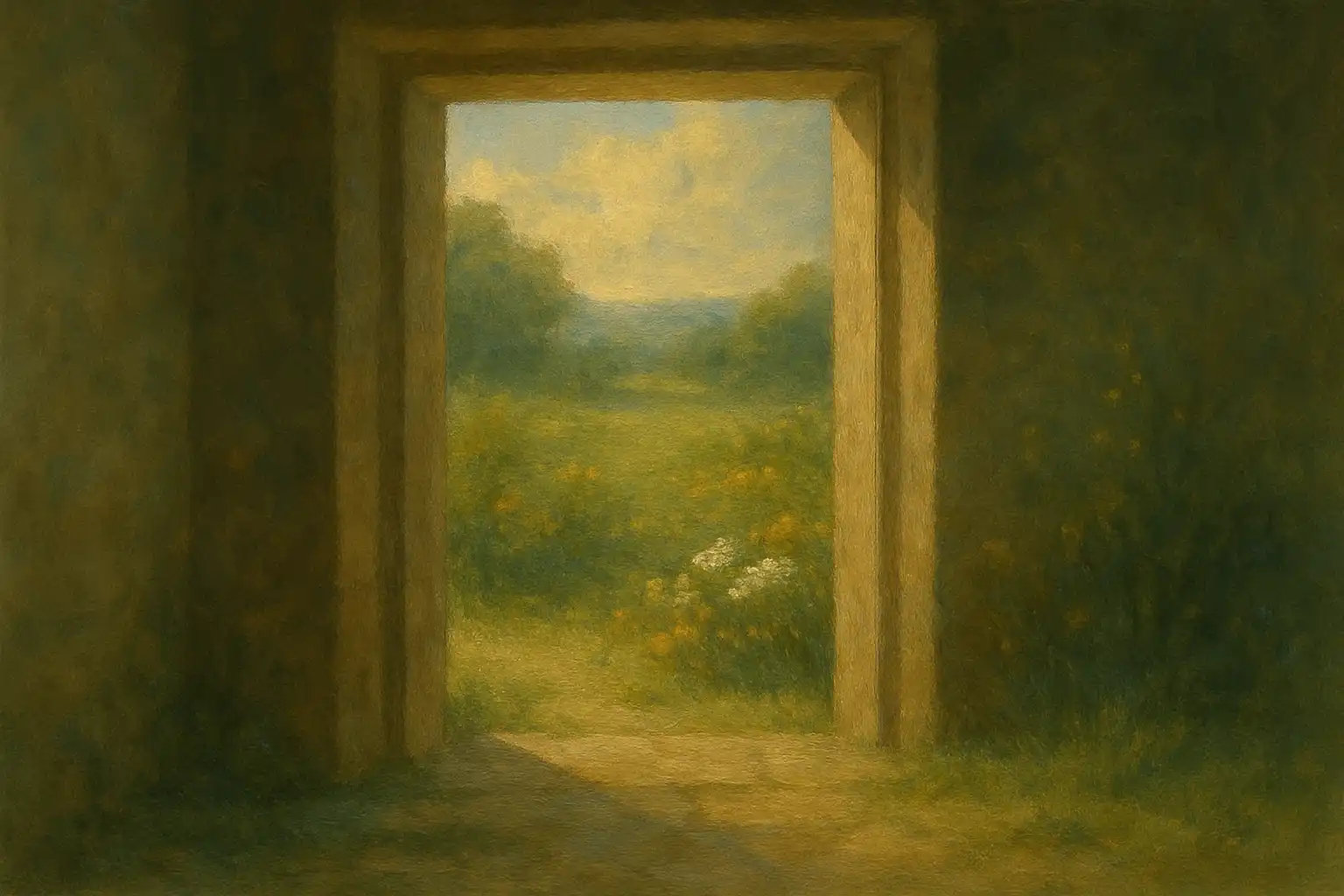
Dickinson’s declaring poetry is better than prose by comparing them to houses. Prose is narrow and confined. Poetry is expansive, full of windows and doors, with the sky itself as a roof. She lives in poetry, dwells in it like it’s an actual place. And that place is bigger, freer, more beautiful than anything prose can offer.
The metaphor makes the abstract concrete. Poetry isn’t just writing, it’s architecture. You can walk through it, look out its windows, stand under its roof. Except the roof is the sky, which means no real ceiling. The chambers are tall as cedar trees. Everything about this house is more, bigger, unlimited.
The poem ends with Dickinson describing her work as spreading her hands wide to gather paradise. That’s what poets do. They reach out with open hands and collect fragments of the divine. Not to own it but to share it through language.
This became one of her most quoted poems about creativity. “I dwell in Possibility” sounds like a manifesto. Dickinson’s claiming poetry as her home, her territory, the place where she actually lives. And she’s saying that place is fairer than anywhere prose can take you.
Table of Contents:
Full Poem Text
First published in 1891 in Poems by Emily Dickinson, Second Series. This poem is in the public domain in the United States.
I dwell in Possibility
by Emily Dickinson
I dwell in Possibility—
A fairer House than Prose—
More numerous of Windows—
Superior—for Doors—
Of Chambers as the Cedars—
Impregnable of Eye—
And for an Everlasting Roof
The Gambrels of the Sky—
Of Visitors—the fairest—
For Occupation—This—
The spreading wide my narrow Hands
To gather Paradise—
Summary and Meaning
Three stanzas describing poetry as a house and explaining why it’s superior to prose.
First stanza: “I dwell in Possibility.” Possibility here means poetry. She lives there, makes her home there. It’s “A fairer House than Prose.” Prose is the other house, the comparison point. But poetry is fairer, more beautiful.
“More numerous of Windows” means poetry has more windows than prose. Windows let in light, let you see out. More windows mean more perspectives, more ways of looking. “Superior—for Doors” means the doors are better in poetry’s house. Doors let you move between spaces, enter and exit. Superior doors suggest easier passage, more freedom of movement.
Second stanza expands the house. “Of Chambers as the Cedars” compares the rooms to cedar trees. Cedars are tall, strong, fragrant. The chambers have that same height and strength. “Impregnable of Eye” means you can’t fully see them, can’t penetrate or comprehend their full extent with vision alone. They’re beyond complete observation.
“And for an Everlasting Roof / The Gambrels of the Sky.” Gambrels are a type of roof with two slopes on each side. But here the gambrels are made of sky. The roof is literally the sky, which means this house has no real ceiling. It opens directly into infinity. “Everlasting” emphasizes permanence and eternality.
Third stanza shifts to purpose. “Of Visitors—the fairest” suggests the people who come to this house of poetry are the best visitors. Who they are exactly isn’t specified. Maybe readers, maybe ideas, maybe inspirations.
“For Occupation—This—” introduces her work. What does she do in this house? “The spreading wide my narrow Hands / To gather Paradise.” Her hands are narrow (limited, human) but she spreads them wide (opens them, reaches). She’s gathering paradise, collecting pieces of something divine or perfect. That’s her occupation as a poet. Not building or creating from nothing but gathering what’s already there and making it accessible.
The meaning: poetry is an expansive, limitless space compared to prose’s narrowness. Living in poetry means dwelling in endless possibility, seeing through countless windows, moving through superior doors, standing under the infinite sky. And the work of poetry is reaching out to collect fragments of paradise and bring them into language.
Themes and Analysis
Poetry as Superior to Prose
The comparison is right in the opening. Prose is a house. Poetry is a fairer house. Dickinson’s not subtle about preference. Prose is narrow, confined, limited. Poetry is expansive, numerous, superior.
The specific comparisons matter. More windows means more ways of seeing. Superior doors means easier access and movement. Poetry doesn’t just contain more, it allows more. It’s architecturally designed for freedom in ways prose isn’t.
Boundlessness and Infinity
The house keeps expanding beyond normal limits. Chambers tall as cedars aren’t regular rooms. A roof made of sky isn’t a real ceiling. Dickinson’s taking the house metaphor and stretching it until it becomes cosmic.
“Impregnable of Eye” means the chambers can’t be fully seen or understood. They resist complete comprehension. That’s poetry too. You can’t exhaust it, can’t see all of it at once.
The everlasting roof made of sky’s gambrels is the poem’s most striking image. Gambrels are barn-style roofs with double slopes. But making them out of sky means the house opens directly into infinity. No ceiling, no limit, just endless upward expanse.
Gathering vs Creating
The final stanza is about occupation, what the poet does. And what she does is gather. Not create, not make, but gather. “Spreading wide my narrow Hands / To gather Paradise” suggests poetry is about collection, about reaching for what’s already out there and bringing it together.
“Narrow Hands” acknowledges limitation. She’s human, finite, limited in reach. But “spreading wide” is the effort to extend beyond those limits. The gesture is open-handed, receptive. You gather with open hands, not closed fists.
“Paradise” is what she’s gathering. Fragments of perfection, pieces of the divine, moments of transcendence. Poetry doesn’t create paradise, it gathers it. It finds what’s already there and makes it visible, available, shareable through language.
That’s a humble view of the poet’s role in some ways. You’re not God creating from nothing. You’re human reaching out to collect what’s scattered around you. But it’s also exalted because what you’re gathering is paradise itself.
Dwelling as Identity
“I dwell in Possibility” makes living in poetry not just metaphor but identity. Dickinson’s not visiting poetry, not working in poetry. She dwells there. It’s where she lives, where she makes her home.
That suggests poetry isn’t just what she does. It’s who she is. Her entire existence is structured around this imaginative space. She’s a permanent resident, not a tourist. That commitment, that fullness of habitation, is what makes the poem feel so definitive.
For someone who lived physically in Amherst, rarely leaving her house, claiming to dwell in possibility is claiming an internal spaciousness that counters external limitation. She might be physically confined but imaginatively she’s got infinite space, countless windows, superior doors, and the sky for a roof.
Structure and Form
Three stanzas, four lines each. Twelve lines total. Compact form for a poem about expansiveness.
Rhyme scheme is ABCB. Prose/windows/doors (slant rhymes). Cedars/eye/roof/sky. Fairest/this/hands/paradise. The rhymes are loose, not perfect. That imperfection matches the idea of poetry as less constrained than formal prose.
Meter is roughly iambic but irregular. The rhythm isn’t strict, which suits a poem about freedom and possibility.
Dickinson’s dashes control pacing. “I dwell in Possibility—” creates suspense before identifying it as a house. “For Occupation—This—” emphasizes what follows.
Capitalization is significant. Possibility, House, Prose, Windows, Doors, Chambers, Paradise all capitalized. Everything important gets elevated to concept status.
The structure moves from exterior to interior to purpose. First stanza describes the outside (windows, doors). Second describes the inside (chambers, roof). Third describes what happens there (gathering paradise).
Historical and Literary Context
Written early 1860s. Published posthumously in 1891 in Second Series edited by Todd and Higginson. They altered punctuation as usual but the core house metaphor survived intact.
The poem reflects Romantic and Transcendentalist ideas about imagination and creativity. Emerson wrote about the poet as seer, someone who perceives truths others miss. Dickinson’s working in that tradition but making it personal and domestic. She’s not talking about poets generally. She’s talking about where she lives.
The prose vs poetry distinction mattered in 19th-century literary culture. Prose was associated with realism, utility, the marketplace. Poetry was associated with beauty, truth, the ideal. Dickinson’s binary reflects those assumptions but personalizes them. Prose is where other people live. Poetry is her home.
The house metaphor itself is interesting given Dickinson’s biography. She spent most of her adult life in her family’s house in Amherst, rarely leaving. Her physical dwelling was limited. But she’s claiming a different kind of dwelling, an imaginative one that’s unlimited. That makes the poem both compensation for and transformation of her actual circumstances.
Within her body of work, this is one of her clearest statements about poetry as vocation. Other poems explore death, nature, faith, love. This one’s explicitly about the act of writing, the space of imagination, the work of gathering language. It’s meta-poetic, poetry about poetry.
The poem influenced later poets and artists who wanted language for why creative work matters. “I dwell in Possibility” became a shorthand for claiming imagination as essential territory, not optional decoration. Artists cite it when defending the value of what they do.
Significance and Impact
It’s one of her most quoted poems about creativity. Artists and writers reference it constantly because it validates imaginative work as serious dwelling, not frivolous hobby. Saying “I dwell in Possibility” is claiming poetry as home, as essential space, as where you actually live.
The metaphor of poetry as architecture is memorable and expandable. You can build on it (no pun intended). Educators use it to teach about extended metaphor. It’s clear enough to understand but rich enough to explore.
The poem demonstrates Dickinson’s ability to make abstract ideas concrete. Poetry becomes a house you can picture, walk through, live in. That concreteness makes philosophical claims accessible. Instead of abstract argument about why poetry matters, she just describes the house and lets you see why you’d want to live there.
The final image of gathering paradise influenced thinking about what poets do. Not creating from nothing but gathering what’s already there and making it visible. That’s a less Romantic, more humble view of artistic work that still grants it significance.
The poem also matters for what it reveals about Dickinson’s sense of her own work. She’s not apologizing for spending her life writing poems. She’s declaring it as dwelling in the best possible house. That confidence, that assertion of poetry’s value, helped later poets justify their own commitment to the craft.
Famous Lines and Quotes
“I dwell in Possibility—”
The opening declaration. Makes poetry a place of residence. “Dwell” means live permanently, not just visit. “Possibility” suggests unlimited potential. Together they make poetry not just writing but a way of existing in the world.
“A fairer House than Prose—”
The comparison that drives the whole poem. Prose is a house. Poetry is a fairer house. Simple, direct, confident. Dickinson’s not arguing the case, just stating it as fact.
“More numerous of Windows— / Superior—for Doors—”
The specific architectural advantages of poetry. More ways of seeing (windows), better ways of moving (doors). That specificity makes the metaphor work. She’s not just saying poetry is better. She’s showing how it’s better.
“And for an Everlasting Roof / The Gambrels of the Sky—”
The moment the metaphor breaks into infinity. Gambrels are real architectural features but making them out of sky turns the house limitless. The roof opens into eternity. That’s the poem’s most striking image, where domestic meets cosmic.
“The spreading wide my narrow Hands / To gather Paradise—”
The closing gesture. Narrow hands acknowledging limitation. Spreading wide showing effort to extend beyond it. Gathering paradise as the goal. That combination of humility (narrow hands) and ambition (gathering paradise) captures the poet’s role perfectly.
Conclusion
I dwell in Possibility is Dickinson announcing poetry as her home territory. Not just what she writes but where she lives. She’s made imagination into a house with more windows than prose has, better doors, chambers tall as trees, and the sky itself as a roof. That house doesn’t confine. It expands. It opens into infinity.
The final image of spreading narrow hands to gather paradise captures what poets do in Dickinson’s view. They reach for pieces of perfection and bring them into language. Not creating paradise but gathering it, making it accessible, sharing it through words. That’s the occupation of living in possibility.
What makes the poem last is how it turns an abstract idea (poetry’s value) into something concrete (a house you can picture). The metaphor is clear enough to understand immediately but rich enough to keep exploring. You can see the windows, feel the superior doors, stand under that sky-roof. And once you’ve seen poetry as that kind of dwelling, it’s hard to go back to thinking of it as just words on a page.
The poem works as both description and defense. Dickinson’s describing where she lives imaginatively while defending why that dwelling matters. Poetry isn’t narrow like prose. It’s expansive, unlimited, open to infinite possibility. And for someone whose physical life was largely confined to one house in Amherst, claiming that imaginative spaciousness was both compensation and triumph. She might not travel physically, but in possibility she dwells in endless space with the sky for a roof. That’s freedom of a different kind.
Frequently Asked Questions About I dwell in Possibility
What does “Possibility” mean in this poem?
Possibility means poetry itself. Dickinson’s using it as a metaphor for the imaginative space poetry creates. She dwells in poetry, lives in it, makes it her home. Calling it “Possibility” emphasizes poetry’s openness, its unlimited potential, its capacity for endless exploration and discovery. Unlike prose, which she sees as narrow and confined, poetry offers boundless opportunities for perspective and movement.
Why does Dickinson compare poetry to a house?
The house metaphor makes the abstract idea of imagination concrete and livable. By giving poetry windows, doors, chambers, and a roof, she shows it’s not just theory but actual dwelling space. You can live in it, move through it, see out of it. The metaphor starts domestic and familiar, then expands into something cosmic when the roof becomes the sky. That movement from concrete to infinite captures poetry’s range.
What does “fairer House than Prose” mean?
Dickinson’s declaring poetry superior to prose. “Fairer” means more beautiful, better. Prose is the comparison house, serviceable but narrow and confined. Poetry is the upgraded version with more windows (more perspectives), superior doors (easier passage), taller chambers, and infinite ceiling. She’s not subtle about preferring poetry. It’s explicitly the better dwelling.
What are “The Gambrels of the Sky”?
Gambrels are a type of roof with two slopes on each side, common on barns. But Dickinson makes them out of sky, which means the roof opens directly into infinity. There’s no real ceiling, no cap on imagination. The house of poetry doesn’t confine you under a normal roof. It opens upward forever. That image of sky as architecture turns the domestic metaphor cosmic.
What does it mean to “gather Paradise”?
This describes the poet’s work. She spreads her hands wide (reaches out, opens herself) to gather paradise (collect fragments of perfection or the divine). Poetry isn’t about creating something from nothing. It’s about gathering what’s already there, scattered pieces of beauty and truth, and bringing them together through language. The gesture is receptive, humble, open-handed rather than grasping.
When was this poem published?
First published in 1891 in Poems by Emily Dickinson, Second Series, five years after her death. Like most of her work, it wasn’t published during her lifetime. The editors Todd and Higginson altered some punctuation but the core house metaphor remained intact. Modern editions restore her original dashes and capitalization.
Why is this poem important?
It’s one of Dickinson’s clearest statements about poetry’s value and her own identity as a poet. By claiming she dwells in possibility, she’s making poetry not just her work but her home, her essential territory. The poem validates imaginative work as serious and necessary, not decorative or frivolous. Artists and writers quote it constantly because it gives language to why creative work matters and why imagination needs defending as essential space.
Explore More Dickinson
If you enjoyed our analysis, keep exploring Dickinson’s works with the following articles: