
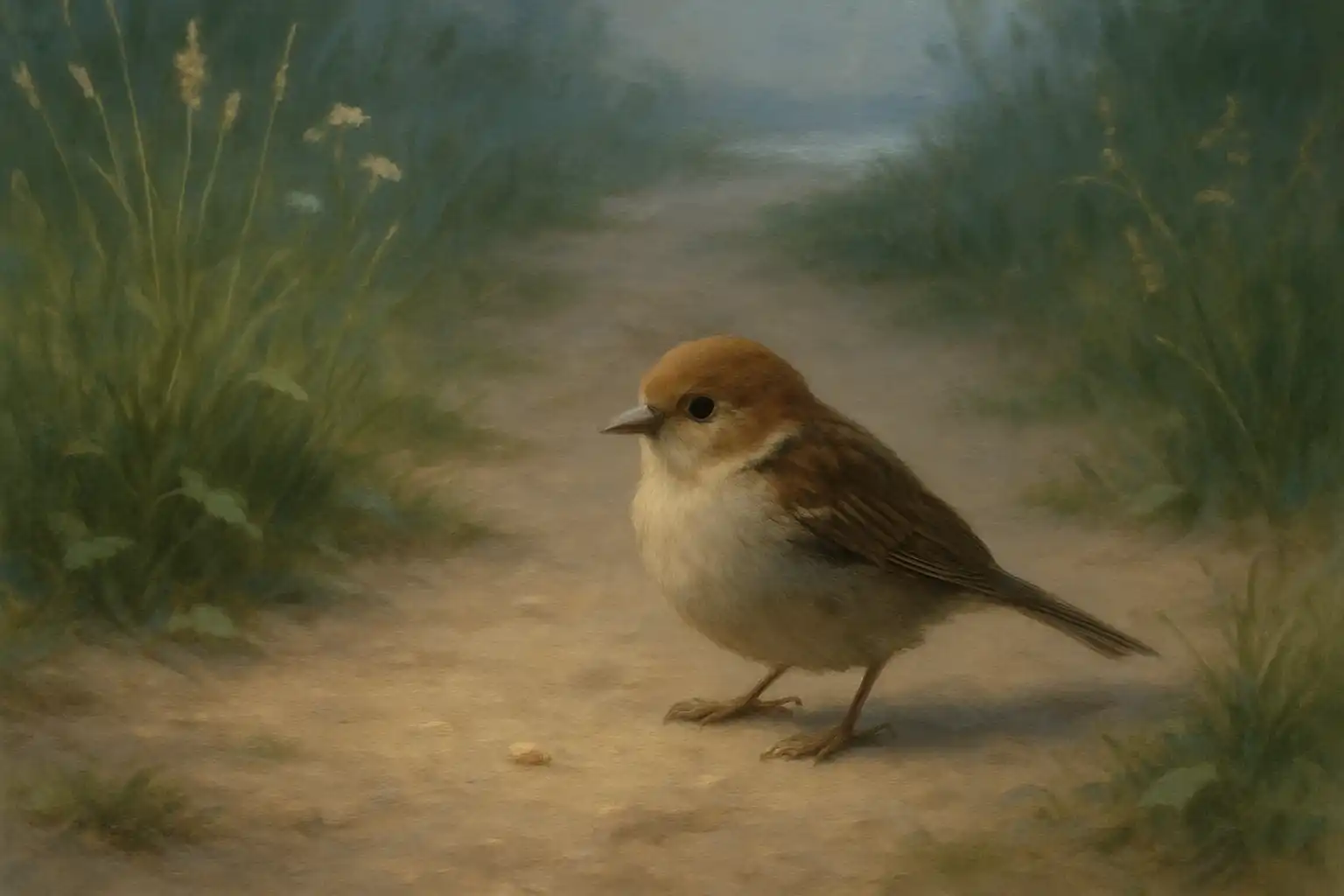
Dickinson watched a bird and turned it into one of her best nature poems. That’s the whole setup. She’s observing this bird moving along a path, doing bird things, completely unaware it’s being watched. It eats a worm, drinks some dew, hops around, then flies off when she tries to offer it food. Simple encounter, but Dickinson makes it mean something by how she describes it.
What’s striking is the tonal shift. The poem starts brutal. The bird bites an angleworm in half and eats it raw. No romance there, just survival. Then it gets cautious, nervous, the bird’s eyes darting around like it’s waiting for danger. Then it gets beautiful. When the bird finally takes flight, Dickinson compares it to oars cutting through water, to butterflies gliding through air without leaving a trace. That movement from violent to graceful is what makes the poem work.
It’s also about watching itself. The speaker is observing nature up close, trying to interact with it, and getting rejected. The bird wants nothing to do with human contact. It takes the crumb refusal as an exit cue and flies away. That distance matters. Nature doesn’t need us, doesn’t want our interference, operates on its own terms. Dickinson captures that independence while also showing how breathtaking it can be when you actually pay attention to what’s happening right in front of you.
Table of Contents:
Full Poem Text
First published in 1891 in Poems by Emily Dickinson, Second Series. This poem is in the public domain in the United States.
A Bird came down the Walk
by Emily Dickinson
A bird came down the walk:
He did not know I saw;
He bit an angle-worm in halves
And ate the fellow, raw.
And then he drank a dew
From a convenient grass,
And then hopped sidewise to the wall
To let a beetle pass.
He glanced with rapid eyes
That hurried all abroad,
They looked like frightened beads, I thought;
He stirred his velvet head
Like one in danger; cautious,
I offered him a crumb,
And he unrolled his feathers
And rowed him softer home
Than oars divide the ocean,
Too silver for a seam,
Or butterflies, off banks of noon,
Leap, splashless, as they swim.
Summary and Meaning
Speaker’s watching a bird that doesn’t know it’s being observed. That detail sets up the whole poem. The bird isn’t performing or aware of an audience. It’s just doing what birds do.
First action: it bites an angleworm in half and eats it raw. “The fellow, raw” is such a weird way to phrase that. “Fellow” makes the worm sound almost human, which makes eating it sound more brutal. No cooking, no preparation, just snap and swallow. That’s nature at its most basic. Survival isn’t pretty.
Then it drinks dew from grass, which sounds more delicate. Then hops sideways to let a beetle pass, which is almost polite. So the bird goes from predator to something careful and considerate in two stanzas. That range is part of what Dickinson’s showing. The bird contains multitudes, to borrow from Whitman.
Third stanza shifts to the bird’s wariness. Its eyes move fast, “like frightened beads.” Not calm observation but nervous scanning. The bird’s always on alert, always ready to bolt. Its head has “velvet” texture but moves “like one in danger.” So there’s softness and fear coexisting.
Speaker tries to bridge the gap by offering a crumb. Human reaching toward nature, attempting connection. The bird’s response? Flies away. “Unrolled his feathers” like unfurling sails, then takes off. That’s the rejection. Nature doesn’t want what we’re offering. It has its own food, its own path, its own reasons for leaving.
Final stanza is where the poem becomes memorable. The bird’s flight gets compared to oars dividing ocean water, “too silver for a seam.” The movement is so smooth there’s no visible break in the water. Then butterflies off “banks of noon” that leap “splashless, as they swim.” That’s not how butterflies or swimming work literally, but as metaphor it captures effortless, graceful motion through air.
The meaning: nature up close reveals both violence and beauty, often in the same creature. The bird that tears a worm apart also flies with impossible grace. And humans can watch, can try to interact, but ultimately nature remains separate, independent, and stunning when it moves on its own terms.
Themes and Analysis
Nature’s Dual Character
The poem refuses to make nature only one thing. It’s brutal when the bird eats the worm. It’s cautious when it watches for threats. It’s graceful when it flies. Dickinson’s not romanticizing or condemning nature. She’s showing it as complex, containing contradictions. That honesty is what makes the poem work. Most nature poetry of her era either prettified everything or moralizing about it. This just observes and reports.
The worm-eating detail especially matters. Dickinson could’ve started with the bird drinking dew, which is gentle and poetic. Instead she opens with raw predation. Sets the tone that this isn’t going to be a sentimental nature poem. Then she earns the beautiful ending by grounding it in reality first.
Observation and Distance
The speaker is watching but not participating. “He did not know I saw” establishes that dynamic. The bird’s authentic because it’s unaware of being watched. It’s not performing. But when the speaker tries to close that distance by offering food, the bird rejects it and leaves.
That interaction (or failed interaction) reveals something about the relationship between humans and nature. We can observe, can appreciate, can try to connect, but nature doesn’t need our involvement. The bird has everything it needs without human intervention. The crumb offer is rejected not out of rudeness but because the bird operates independently.
Dickinson’s making a point about boundaries. You can watch nature closely, can describe it accurately, can find meaning in it, but you can’t possess it or control it. The bird flies away precisely when contact is attempted. That independence is part of what makes it worth watching.
Transformation Through Metaphor
The poem’s structure moves from literal description to extended metaphor. First four stanzas are straightforward observation. Bird does X, bird does Y, bird looks scared. Then the final stanza explodes into comparison. Suddenly we’re talking about oars and oceans and butterflies and swimming through air.
That shift mirrors what happens when you pay real attention to something ordinary. At first it’s just a bird. Then if you watch long enough, it becomes something more. The flight isn’t just functional, it’s revelatory. Dickinson’s showing how observation can transform perception. The everyday becomes sublime if you’re patient enough to see it clearly.
The metaphors themselves do specific work. Oars dividing ocean emphasizes the smoothness and power of the motion. Too silver for a seam suggests something seamless, perfect, almost metallic in its shine. Butterflies leaping splashless connects flight to swimming, two different modes of moving through substance (air, water) without disruption. Together these images make the bird’s departure feel like ascension, not just escape.
Fear and Vigilance
The bird’s constant alertness runs through the middle stanzas. “Frightened beads” for eyes, head moving “like one in danger,” the rapid scanning. The bird knows it’s vulnerable. That fear is what keeps it alive. The poem doesn’t judge that wariness. It presents it as natural, necessary.
When the speaker offers the crumb, the bird’s caution proves correct. Unknown hand reaching toward you? Time to leave. That survival instinct might mean missing out on free food, but it also means staying alive. The bird chooses safety over trust, and Dickinson validates that choice by making the resulting flight so beautiful.
Structure and Form
Five stanzas, four lines each. Twenty lines total. Dickinson’s working in her typical compressed form, though this is slightly longer than some of her poems. Each stanza advances the narrative. Bird acts, bird reacts, bird leaves. Simple progression but effective.
Rhyme scheme is roughly ABCB in each stanza. Second and fourth lines rhyme: saw/raw, grass/pass, abroad/head, crumb/home, seam/swim. Not perfect rhymes always (abroad/head is slant rhyme) but enough to create cohesion. The rhymes don’t draw attention to themselves. They just hold the poem together quietly.
Meter is iambic, alternating between tetrameter and trimeter. Four beats, three beats, back and forth. Creates a rhythmic steadiness that matches the observational tone. You’re watching something unfold at its own pace, not rushed or dramatic. The meter reinforces that patience.
Dickinson’s dashes appear throughout, controlling pacing. “They looked like frightened beads, I thought;” uses the dash to separate observation from commentary. “Like one in danger; cautious,” uses a semicolon but the pause works similarly. These punctuation choices make you slow down, notice details, see what the speaker sees.
The shift to extended metaphor in the final stanza breaks the pattern slightly. First four stanzas are contained, complete thoughts. Final stanza spills across lines with comparisons that build on each other. That structural change mirrors the tonal change. You’re no longer watching a bird hop around. You’re watching something transcendent.
Historical and Literary Context
Written early 1860s, same period as most of Dickinson’s major work. Published posthumously in 1891 in the Second Series edited by Todd and Higginson. Standard Dickinson publication story: wrote it in private, shared with maybe a few people, it sat in a drawer until after she died.
The poem reflects Dickinson’s constant attention to the natural world around her Amherst home. She wrote about birds repeatedly. They show up as messengers, as symbols of the soul, as just birds doing bird things. This one falls in the last category mostly, though the flight at the end gets symbolic weight.
Nineteenth-century American poetry loved nature, but usually in specific ways. Transcendentalists found spiritual lessons in every leaf. Romantic poets made nature grandiose and overwhelming. Dickinson does neither. She watches a bird eat a worm and describes it accurately, then watches it fly and finds genuine beauty in that, but she’s not drawing heavy-handed moral conclusions. The observation is the point.
That approach influenced later poets who wanted to write about nature without sentimentality. The imagists especially, with their focus on clear, precise images rather than emotional inflation. Dickinson’s bird eating a worm raw, then flying with grace, that’s the kind of honest observation they were after.
Significance and Impact
It’s one of Dickinson’s most taught nature poems because it’s accessible but not simple. You can understand it on first read (person watches bird, bird flies away) while also finding more depth in the details and metaphors. Perfect for teaching how close observation works in poetry.
The poem demonstrates Dickinson’s range within a single piece. She can be blunt (ate the fellow, raw), precise (frightened beads), and lyrical (splashless, as they swim) all in twenty lines. That versatility shows why she’s considered a technical master.
It also shows her philosophy about nature. She’s not anthropomorphizing or moralizing. The bird is a bird. It acts like a bird. But in watching it closely and describing it accurately, something larger emerges. That approach, treating nature as worthy of attention for its own sake while finding meaning through careful observation, influenced environmental writing and nature poetry that came after.
The final stanza’s metaphors have been quoted constantly since publication. “Rowed him softer home / Than oars divide the ocean” is the kind of line that sticks. It’s beautiful without being vague. You can picture exactly what she means while also feeling the emotional weight of it.
Famous Lines and Quotes
“A bird came down the walk: / He did not know I saw”
Sets the scene with perfect simplicity. The bird’s unaware, which makes everything that follows feel authentic. We’re watching something real, not staged.
“He bit an angle-worm in halves / And ate the fellow, raw”
The violence of “bit in halves” combined with “the fellow” (which sounds friendly) and “raw” (which sounds brutal) creates tension immediately. This isn’t going to be a gentle nature poem.
“They looked like frightened beads, I thought”
The comparison is specific and strange. Beads are hard, round, decorative objects. Eyes being “frightened beads” captures both the shape and the emotion while also making them seem less alive, more object-like. Shows the bird’s fear while also maintaining observational distance.
“And he unrolled his feathers / And rowed him softer home”
The verb choices here are perfect. “Unrolled” makes the wings sound like sails or scrolls, something deliberate. “Rowed” connects flying to rowing a boat, emphasizing the smooth, rhythmic motion. “Softer home” suggests the sky is home, and getting there is gentle despite the bird’s earlier fear.
“Than oars divide the ocean, / Too silver for a seam”
The extended metaphor kicks into high gear. Oars dividing ocean is already graceful, but “too silver for a seam” makes it magical. The water is so perfectly split there’s no visible break, just smooth silver surface. That’s impossibly beautiful and yet describes exactly what smooth flight looks like.
“Or butterflies, off banks of noon, / Leap, splashless, as they swim”
Butterflies don’t swim and don’t make splashes, but combining those images creates the sense of moving through air with the same grace something moves through water. “Banks of noon” is wonderful weirdness. Noon doesn’t have banks. But it suggests light as a substance you can move through, which is how butterflies look when they’re flying in bright sunshine.
Conclusion
A Bird came down the Walk works because Dickinson refuses to simplify what she sees. The bird is predator and prey, brutal and graceful, wary and beautiful. She doesn’t force those contradictions into a neat lesson. She just shows them coexisting in the same creature during a brief encounter.
The poem’s structure mirrors that approach. Start with close, almost harsh observation. Build through details about caution and fear. End with transcendent metaphor that transforms the whole scene. That movement from specific to sublime is classic Dickinson. She trusts that if you describe something accurately enough, the meaning will emerge without you having to announce it.
What lasts is the honesty. Nature isn’t gentle or cruel exclusively. It’s both, depending on where you’re standing and what you’re watching. The bird that snaps a worm in half also flies with impossible grace. Those aren’t contradictions. They’re just different moments in the same life. Dickinson shows that without judgment, without forcing interpretation, and the result is a poem that feels true to what it’s describing. That truth is what keeps people reading it over a century later.
Frequently Asked Questions About A Bird came down the Walk
What is the main idea of the poem?
The poem captures a moment of watching a bird in nature and reveals how ordinary observation can show both violence and beauty in the same creature. Dickinson presents nature without sentimentality, showing the bird eating a worm brutally, then flying away with graceful beauty. The main idea is that nature contains contradictions and operates independently of human interference.
Why does Dickinson describe the bird eating a worm so graphically?
Because she’s being honest about nature. The bird survives by eating other creatures, and Dickinson doesn’t soften that reality. Starting with “bit an angle-worm in halves / And ate the fellow, raw” establishes this isn’t going to be a romanticized nature poem. That brutal opening makes the beautiful ending more earned and meaningful. You can’t have the transcendent flight without first acknowledging the harsh realities of survival.
What happens when the speaker offers the bird a crumb?
The bird rejects it and flies away. The speaker is trying to make contact, to bridge the distance between human and nature, but the bird wants none of it. That rejection reveals nature’s independence. The bird doesn’t need human help or food. It has its own systems for survival. When humans try to interfere, even with good intentions, nature withdraws.
What do the final stanza’s metaphors mean?
The bird’s flight is compared to oars cutting smoothly through ocean water and butterflies gliding through air without disruption. These metaphors transform the bird from a nervous, cautious creature into something graceful and transcendent. Dickinson’s showing how observation can reveal beauty in ordinary moments if you pay close enough attention. The flight isn’t just functional escape, it’s poetry in motion.
Why are the bird’s eyes described as “frightened beads”?
It’s a precise, slightly unsettling comparison. Beads are hard, round, decorative objects, but “frightened” makes them emotional. The combination captures both the physical appearance of the bird’s eyes and their expression of constant wariness. The bird is always alert, always scanning for danger. That fear is what keeps it alive, and Dickinson doesn’t judge it. She just describes it accurately.
What is the poem’s tone?
Observational at first, then transcendent. The speaker starts by watching quietly and reporting what she sees without emotional commentary. The tone is patient, careful, almost scientific in its attention to detail. Then in the final stanza it shifts to something more lyrical and metaphorical. The tone elevates along with the bird’s flight, moving from plain description to something approaching wonder.
Why is this poem important in Dickinson’s work?
It demonstrates her ability to see nature clearly without romanticizing or moralizing. She presents the bird as it is, violent and graceful, fearful and beautiful, and finds meaning through close observation rather than imposed interpretation. The poem influenced later nature poetry by showing how honesty and lyricism can coexist. It’s also one of her most accessible poems while still being technically accomplished and thematically complex.
Explore More Dickinson
If you enjoyed our analysis, keep exploring Dickinson’s works with the following articles: